


Ethnobotany* & Community Building in México’s Cradle of Agriculture
This work was carried out in collaboration with Mexico’s federal system of Biosphere Reserves, a network of natural protected areas that, in contrast to the US National Parks System, works together with Indigenous communities on these protected lands, incorporating traditional ecological knowledge into organizational land use practices while helping local economies to grow sustainably.

2015-2017
My role
Interpretation
Muralism design & coordination
Youth development
*Ethnobotany is the study of how human communities understand and relate to plants, not just as biological resources but also as entities embedded in a culture’s rituals and mythology.

The Helia Bravo Hollis Botanical Garden
is situated in the Tehuacán–Cuicatlán Valley, the site of the domestication of maize and other important Mexican crops, such as beans, chile pepper, and amaranth, among others.

The Tehuacán-Cuicatĺan Biosphere Reserve
sits at the convergence of México’s cool, tropical highlands and its humid, tropical lowlands, making it one of the most biologically and culturally diverse regions in the Americas.

My Work
integrated ecological conservation with education, community partnership, and environmental interpretation, with a focus on ethnobotany.


Transmitting Indigenous Knowledge
through community muralism
At the Jardín Botánico Helia Bravo Hollis in Zapotitlán Salinas, I led an interpretive project centered on community muralism.
Developed in collaboration with the Reserve, the municipal government, and the local guides, guardians of Ngíwa (Popoloca) ecological knowledge, the murals would serve as an accompanying piece to the oral histories and interpretation given during group tours.


The process began with a line drawing over which participants could apply color.
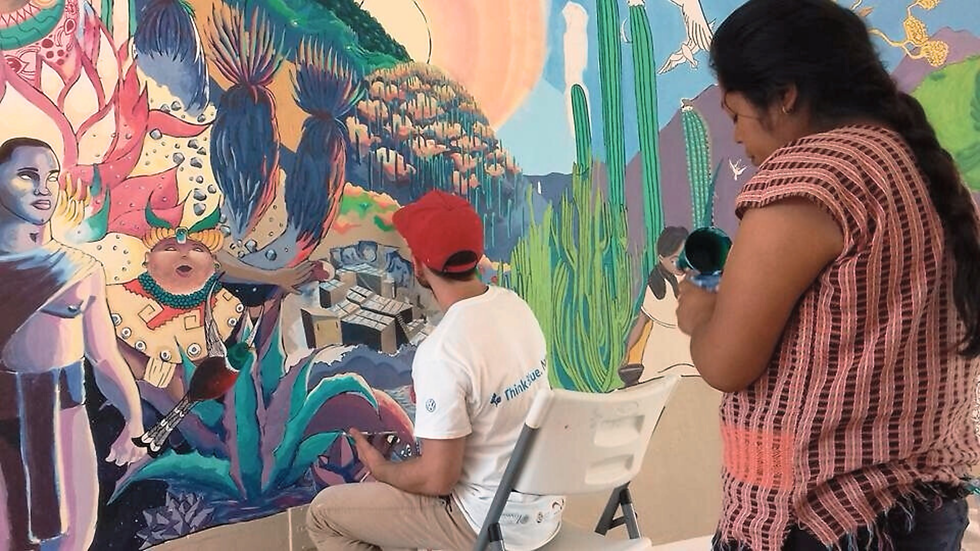
I would participate in the painting days and provide detail work on off days.

The process began with a line drawing over which participants could apply color.

Building capacity
through education & youth development
To demonstrate their commitment to the mutually beneficial cooperation with communities living in the Biosphere Reserve, the agency will initiate joint conservation projects based on local needs, economic stimulation initiatives, and education work.
I coordinated with the municipal government in the community where I lived and worked, Zapotitĺan-Salinas, to support a youth-led initiative that connected climate change resilience, appropriate technologies, and Indigenous knowledge, also known as Traditional Ecological Knowledge (TEK).


The young people I worked with had an interest in appropriate technologies.

We built solar dehydrators, which use sunlight to dry and conserve the crops they were growing and wild fruit.

On a clear day, you can see distant Citlaltépetl (Pico de Orizaba), the highest point in México.
The young people I worked with had an interest in appropriate technologies.
